Tel: +86-0571-61092020 丨 Email:info@at-cable.com
Home / Blog / Tracer Wire Resources / Open Trench vs HDD Tracer Wire: How to Choose

Open Trench vs HDD Tracer Wire: How to Choose

Author: Site Editor     Publish Time: 2026-07-13      Origin: Site

Quick Answer

Open trench and HDD tracer wire should not be selected as if the installation conditions were the same. Open trench work allows the wire to be placed beside an exposed utility before backfilling, so handling and the required strength level are the main considerations. Horizontal directional drilling (HDD) can expose the wire to greater pulling, friction and installation stress, so AITE Cable uses an Extra High-Strength CCS construction with 45 mil HMWPE/HDPE insulation for its HDD series. Final selection must follow the project specification and expected installation conditions.

Tracer wire provides a conductive path that allows non-metallic underground utilities to be located from the surface. The correct construction depends not only on wire gauge, but also on how the utility will be installed. This guide compares AITE Cable's solid copper-clad steel (CCS) tracer wire options for open trench, open cut, directional drilling and trenchless projects.

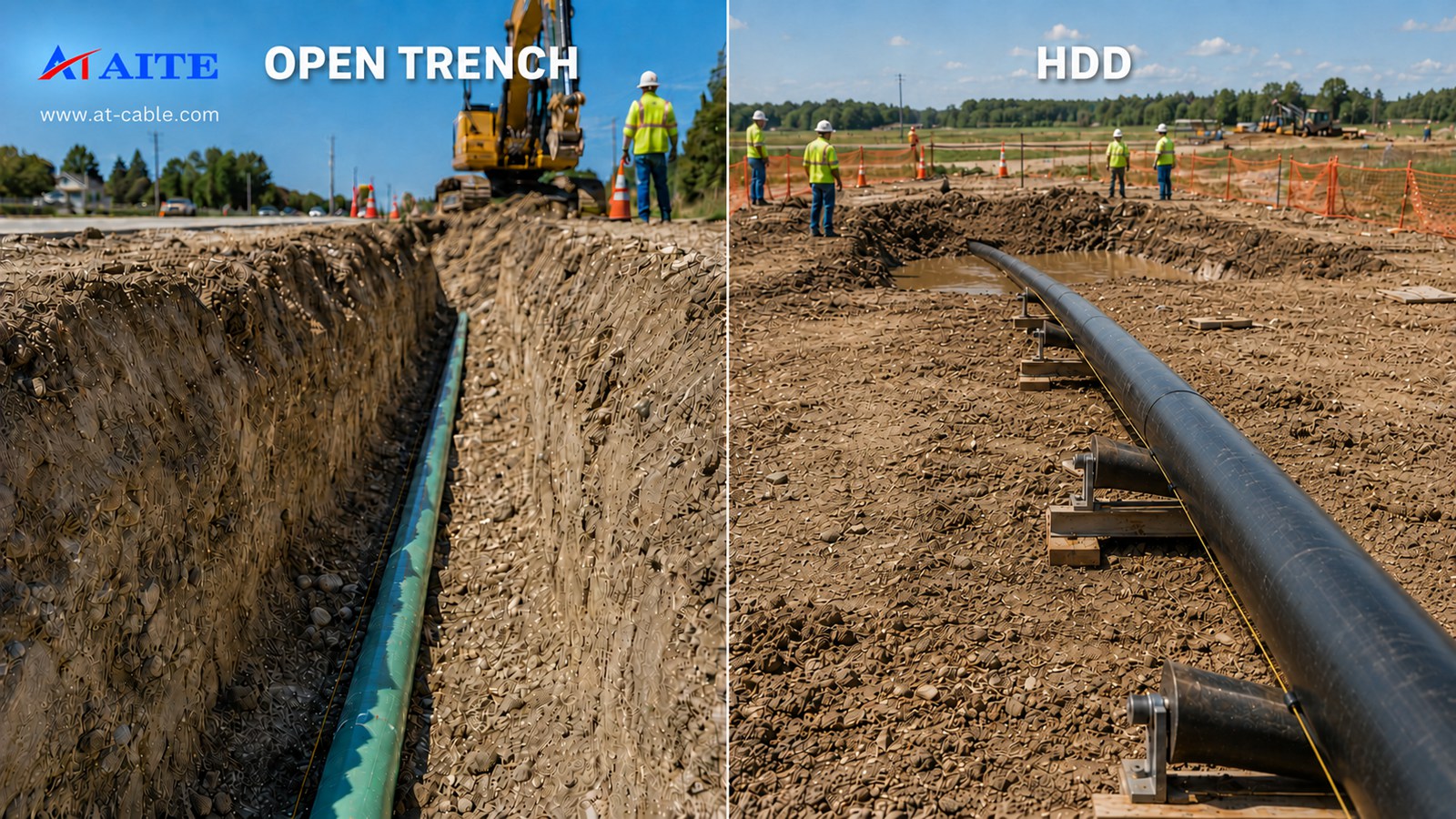
Open trench and HDD tracer wire installation comparison

Open trench places tracer wire beside an exposed utility; HDD requires a wire construction selected for pullback and trenchless installation stress.

Open Trench vs HDD Tracer Wire at a Glance

Selection Factor Open Trench / Open Cut HDD / Directional Drilling
Installation access Utility route is excavated before backfill Utility is pulled through a drilled bore
Main mechanical concern Handling, routing, backfill and required installation durability Pulling force, friction, bending and trenchless installation stress
AITE series High-Flex or High-Strength CCS Extra High-Strength CCS
Insulation options 30 mil or 45 mil HMWPE/HDPE 45 mil HMWPE/HDPE in the current AITE HDD series
Available gauges 18–10 AWG High-Flex; 18–8 AWG High-Strength 12, 10 and 8 AWG Extra High-Strength
Selection basis Handling preference, backfill conditions and specified break load Project pulling requirements, bore conditions and specified break load

Important: This comparison describes AITE Cable product series; it is not a universal engineering specification. The project documents, utility owner, applicable local requirements and engineer should determine the final wire construction.

What Is Open Trench Tracer Wire?

In open trench or open cut construction, the utility is visible before the trench is backfilled. Tracer wire can be routed beside the non-metallic pipe or conduit and connected according to the project's locating plan. Because the route is accessible during placement, the selection can balance field handling with the required mechanical strength.

AITE Cable separates its open trench CCS tracer wire into two strength levels:

  • High-Flex CCS: intended for projects where easier routing, bending and lower recoil are important.
  • High-Strength CCS: intended for open trench work that requires a higher break load and additional installation durability.

See the complete High-Flex and High-Strength CCS tracer wire for open trench specifications.

What Is HDD Tracer Wire?

Horizontal directional drilling installs a utility through a drilled bore rather than an open excavation along the full route. During pullback, the tracer wire may encounter higher pulling force, surface friction, bending and variable underground conditions. A wire selected only for ordinary open trench handling may not provide the mechanical margin required by the HDD specification.

AITE Cable's HDD product uses an Extra High-Strength solid CCS conductor with 45 mil HMWPE/HDPE direct-burial insulation. The stronger series is intended for directional drilling, boring and other trenchless utility locating applications where the project requires a higher break load.

Review the Extra High-Strength CCS tracer wire for HDD product page.

Why Wire Gauge Alone Is Not Enough

Two tracer wires with the same AWG size can have different conductor constructions and break loads. Insulation thickness also describes the protective polymer layer; it does not by itself determine conductor strength. Buyers should therefore specify both the gauge and required strength series.

AITE 12 AWG Series AITE Product Break Load Insulation Primary Installation Category
High-Flex CCS 302 lb 30 mil or 45 mil Open trench / open cut
High-Strength CCS 452 lb 30 mil or 45 mil Open trench / open cut
Extra High-Strength CCS 1,190 lb 45 mil HDD / directional drilling

Values above are AITE Cable product data for comparison within the current product range. They do not replace project-specific pulling calculations or approval.

How to Select Between Open Trench and HDD Tracer Wire

  1. Confirm the installation method. State whether the route is open trench, open cut, plow-in, conduit, directional drilling or another trenchless method.
  2. Check the project specification first. Identify any required conductor construction, AWG size, break load, insulation thickness, voltage rating, color or referenced standard.
  3. Review expected mechanical stress. Consider the pullback method, route length, bore and soil conditions, bending, backfill and handling requirements with the responsible project team.
  4. Select the strength series. Choose High-Flex or High-Strength for matching open trench requirements; use Extra High-Strength when the HDD specification requires the higher-strength construction.
  5. Confirm insulation and identification. Select 30 mil or 45 mil where available, then confirm the required utility color and surface marking. Local and project requirements control color selection.
  6. Complete the purchasing details. Provide spool length, packaging, private-label marking, estimated quantity and destination.

A Simple Selection Rule

If the utility route is fully excavated, start with the open trench series. If the utility and tracer wire will be pulled through a directional bore, start with the HDD series and confirm the specified pulling requirements. Do not assume that a thicker insulation layer alone converts an open trench conductor into an HDD conductor.

Common Selection Mistakes

  • Choosing by AWG only: the same gauge may be available in different strength constructions.
  • Using insulation thickness as a strength rating: 30 mil and 45 mil describe insulation thickness, not conductor break load.
  • Leaving the installation method out of the RFQ: this prevents the manufacturer from distinguishing open trench from HDD requirements.
  • Treating APWA colors as a universal product approval: color supports utility identification, but the applicable project and local requirements still control.
  • Using tracer wire as a power or grounding conductor: tracer wire provides a locating path and should not be specified as an electrical power cable or grounding conductor.

RFQ Information for a Faster Specification Review

Installation
Open trench, open cut, plow-in, conduit, HDD or other trenchless method
Wire construction
Required series, AWG, break load and insulation thickness
Identification
Utility application, insulation color and surface marking
Commercial details
Spool length, packaging, quantity, destination and target schedule

For a complete purchasing checklist, use the Tracer Wire RFQ Checklist for distributors and utility buyers.

Frequently Asked Questions

Can open trench tracer wire be used for HDD?

Do not assume that it can. HDD may expose the wire to greater pulling and friction than open trench placement. Use the construction required by the project specification; AITE Cable provides an Extra High-Strength CCS series for HDD and trenchless applications.

Does 45 mil insulation automatically make tracer wire suitable for HDD?

No. Insulation thickness affects outer protection, while conductor construction determines break load. Both must be reviewed against the installation method and project requirements.

Which AITE tracer wire is intended for standard open trench work?

High-Flex CCS is intended where easier handling is important. High-Strength CCS is available where the open trench specification requires a higher break load or additional installation durability.

Why is CCS used for tracer wire?

Solid copper-clad steel combines a copper-clad outer surface with a steel core. In AITE Cable's tracer wire range, this construction provides a conductive locating path together with defined mechanical-strength options for different installation methods.

Can the color, marking and spool length be customized?

Yes. AITE Cable supports project-based insulation colors, surface marking, spool length, reel or drum packing and private-label requirements. Availability should be confirmed with the complete specification and quantity.

What should be included in an HDD tracer wire inquiry?

Provide the installation method, required AWG, break load, insulation thickness, voltage rating if specified, color, marking, spool length, packaging, quantity, destination and applicable project specification.

Send Your Open Trench or HDD Specification

AITE Cable can review the installation method, strength level, insulation, color, spool length and OEM packaging requirements for your tracer wire project.

Request Project Pricing Download Datasheet

Email: info@at-cable.com  |  Explore all AITE CCS tracer wire options.

Product Category

Contact Us
Hangzhou Aite cable Co., Ltd. is a China-based wire & cable manufacturer specializing in tracer wire for underground utility locating, with additional OEM cable manufacturing capabilities for LAN cable, coaxial cable, alarm cable, fire alarm cable, control cable and low-voltage cable products.

Products

Quick Links

Contact Us

Tel: +86-0571-61092020
Mob: +86 189 6802 3802
Add: No.556 Shangpan, Jinnan Subdistrict, Lin'an City, Hangzhou Zhejiang, China
Copyright © 2026 HANGZHOU AITE CABLE CO., LTD.. All rights reserved.