
Author: Jack Publish Time: 2026-04-21 Origin: Site
Tracer wire is installed with non-metallic underground utilities so the buried route can be located later from the surface.
It is commonly used with gas, water, sewer, irrigation, communication conduit and other underground infrastructure where the pipe or conduit itself cannot be located electrically.
This guide covers how tracer wire works, conductor construction, utility-identification colors, insulation, Open Trench versus HDD installation, and the main technical details used when comparing tracer wire products.

On this page: What tracer wire is · How it works · Utility colors · CCS vs copper · 30V / 600V · Open Trench vs HDD · Installation
Tracer wire, sometimes called locator wire or locating wire, is an insulated conductor installed along a buried non-metallic utility. A locating transmitter can apply a signal to the wire, allowing a receiver above ground to follow the route.
Its function is to provide a continuous electrical path for underground utility locating.
The locating system needs access to the tracer wire at a test station, valve box or another termination point. A transmitter places a signal on the conductor, and the receiver follows that signal from the surface.
Continuity is important. Splices, connectors, terminations and damaged insulation can affect the locating circuit.
Tracer wire is commonly installed with non-metallic underground utilities including:
In North American utility work, tracer wire insulation is commonly selected to match the utility color convention. The APWA Uniform Color Code provides the following facility-identification references.
| Color | Utility Identification |
|---|---|
| Yellow | Gas, oil, steam, petroleum or gaseous materials |
| Blue | Potable water |
| Green | Sewers and drain lines |
| Orange | Communication, alarm or signal lines, cables or conduit |
| Red | Electric power lines, cables, conduit and lighting cables |
| Purple | Reclaimed water, irrigation and slurry lines |
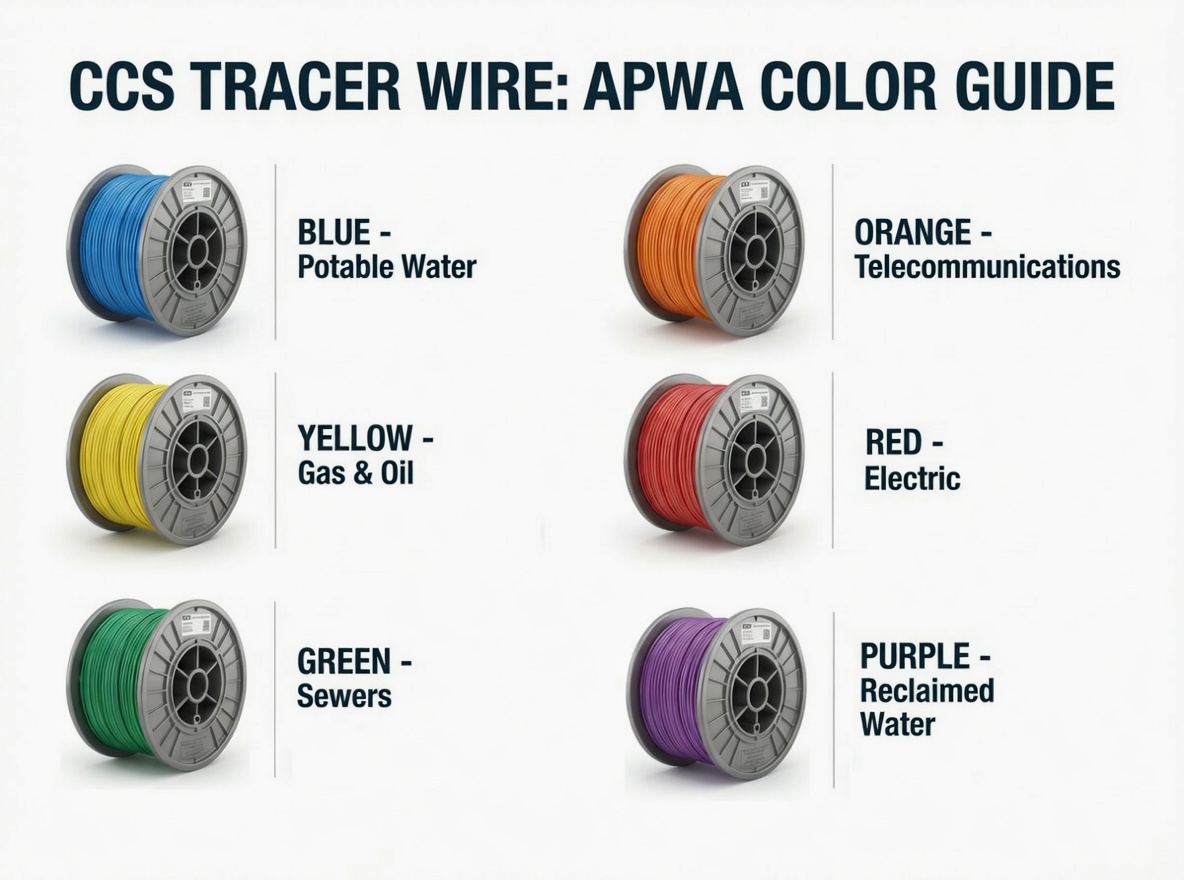
Reference: APWA Uniform Color Code
Copper-clad steel and solid copper can both provide a conductive locating path, but the conductor constructions have different mechanical and commercial characteristics.
| Comparison | CCS Tracer Wire | Solid Copper Tracer Wire |
|---|---|---|
| Conductor | Solid copper-clad steel | Solid copper |
| Cost | Approximately 30–50% lower | Higher copper-material cost |
| Theft Risk | Near-zero theft risk | Higher scrap value and theft incentive |
| Weight | About 10% lighter | Heavier comparable construction |
| Corrosion Resistance | Better corrosion resistance | Depends on conductor and project environment |
| Mechanical Characteristics | Steel-core construction with multiple strength series | Softer conductor construction |
| Conductivity | 21% IACS for the current AITE CCS range | Higher electrical conductivity |
AITE Cable's current CCS tracer wire range uses HMWPE/HDPE direct-burial insulation in the following constructions:
| Insulation Thickness | Voltage Rating | Current AITE Product Range |
|---|---|---|
| 30 mil | 30V | High-Flex and High-Strength Open Trench constructions |
| 45 mil | 600V | Open Trench constructions and Extra High-Strength HDD range |
Open Trench and HDD are different installation methods, and AITE separates its CCS tracer wire range accordingly.
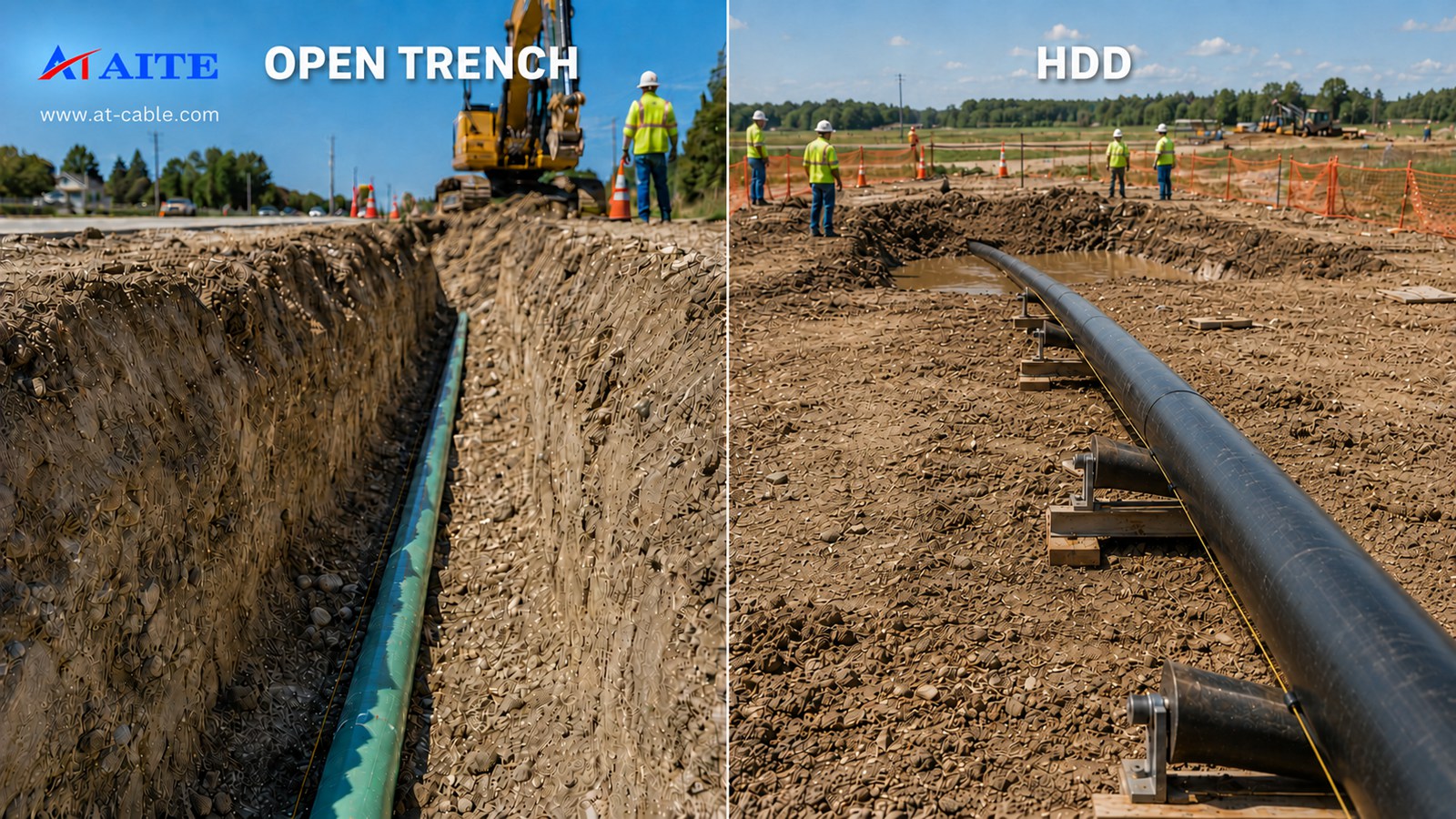
AITE's Open Trench range includes High-Flex and High-Strength solid CCS tracer wire. High-Flex uses copper-clad soft steel for easier routing and handling, while High-Strength uses copper-clad hard steel for higher product break load.
Both series are available in 30 mil / 30V and 45 mil / 600V constructions. View Open Trench specifications .
AITE's current HDD range uses Extra High-Strength solid CCS tracer wire in 12, 10 and 8 AWG with 45 mil / 600V HMWPE/HDPE insulation.
View HDD specifications · Read the detailed Open Trench vs HDD comparison
When comparing tracer wire products, check the complete construction and purchasing requirements.
AITE supplies solid CCS tracer wire on a specification basis with OEM options for insulation color, marking, reel or drum length, labeling and packaging. Common reel lengths are 500 ft, 1,000 ft and 2,500 ft; other lengths are available upon request.
Utility identification: APWA Uniform Color Code
AITE product data: AITE CCS Tracer Wire Datasheet
Tracer wire provides a conductive locating path alongside non-metallic underground utilities so the buried route can later be detected from the surface.
CCS means copper-clad steel. The conductor has a steel core with copper cladding and is different from CCA, solid copper and stainless-steel wire.
Yes. OEM options include insulation color, surface marking, reel or drum length, labeling, packaging and private-label requirements.
Have a project specification, current supplier datasheet, drawing or RFQ? Send it directly to AITE with the estimated quantity.
If a complete specification is not available, send the AWG, insulation thickness, color and estimated quantity.
Jack · International Sales | Cable & Wire Projects
Jack works with AITE Cable customers on cable and wire specifications, OEM and private-label requirements, packaging, project RFQs and production coordination.
Related: CCS Tracer Wire · What Is CCS Tracer Wire? · Open Trench vs HDD · Tracer Wire Resources
Last updated: August 25, 2026.
For more underground utility locating articles, visit AITE Tracer Wire Resources.


